Every year, humanity releases roughly 42 billion tonnes of carbon dioxide into the atmosphere. We burn fossil fuels, clear forests, and change how we use land. Despite global pledges, emissions keep rising.
The math of the Paris Agreement’s 1.5°C target is unforgiving: deep emissions cuts are essential, but they are no longer enough. We also need to actively remove carbon dioxide from the air on a massive scale.
This has triggered a quiet but intense global competition—not for oil or minerals, but for land. And at the heart of this competition lies a profound dilemma: the very strategies we rely on to pull carbon out of the sky may, if done carelessly, destroy the natural habitats we are trying to protect.
The Promise and the Peril of Nature-Based Solutions.
The most mature and scalable carbon removal strategies are surprisingly low-tech. Plant a tree. Grow a crop of switchgrass or miscanthus. Let a forest regrow. These are forms of what scientists call “land-based carbon removal.”
They are attractive because they work with nature, not against it. A single square kilometre of new forest can sequester thousands of tonnes of CO₂ over decades. Energy crops can be burned for electricity, with the resulting emissions captured and stored underground—a technology known as BECCS (Bioenergy with Carbon Capture and Storage).
But here is the catch: these strategies require vast amounts of land. We are talking about millions of square kilometers—an area larger than India.
Where does that land come from? And what lives there now?

When Good Intentions Clash.
A recent study by climate scientist Ruben Prütz and his team, published in Nature Climate Change, provides the most detailed answer yet. The researchers analyzed widely used decarbonization scenarios—roadmaps that show how our energy, economy, and land use must change to meet 1.5°C.
They then overlapped these future land-use maps with two critical biodiversity datasets:
- Climate refugia: Areas where climate change occurs relatively slowly, offering shelter for species fleeing heat and drought.
- Biodiversity hotspots: Regions with exceptionally high concentrations of unique and endangered species.
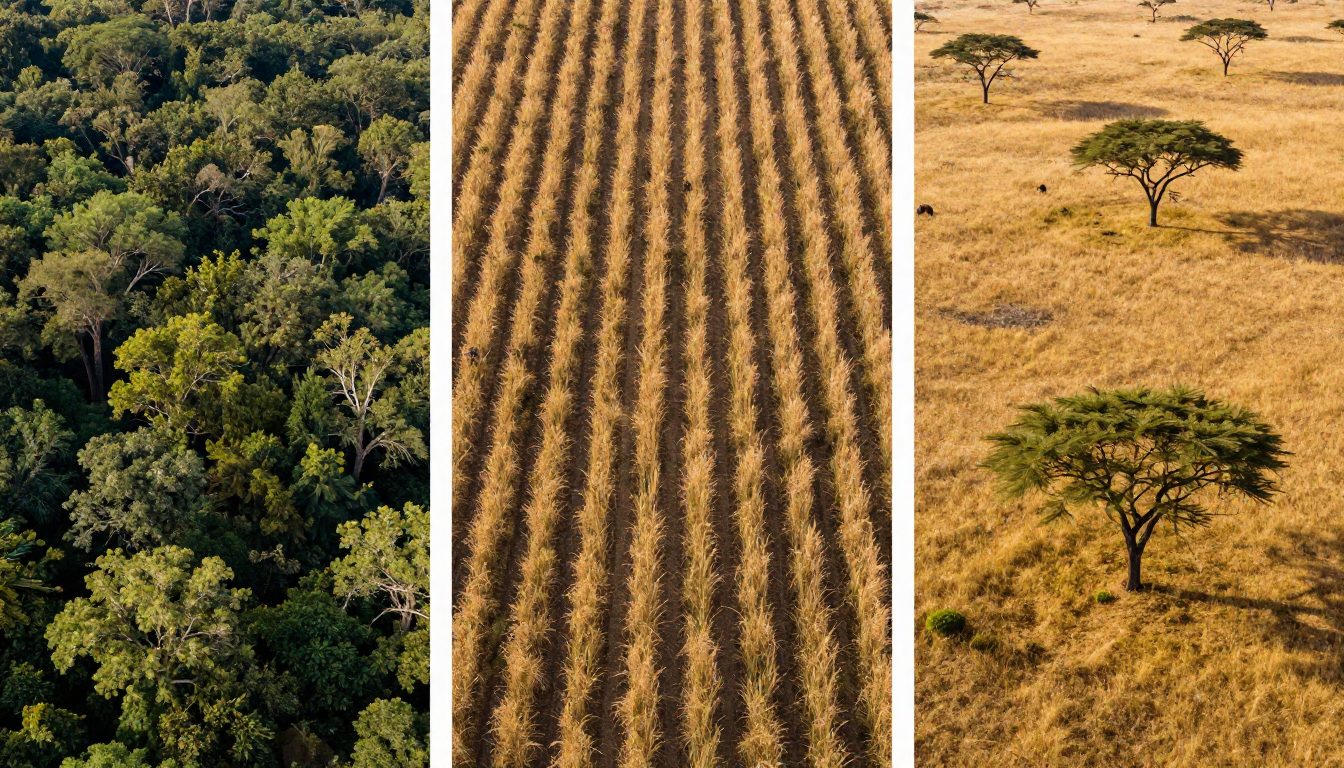
The results were sobering. Under ambitious climate scenarios, up to 13% of the world’s climate refugia would be allocated to land-intensive carbon removal projects. In many cases, this overlap is not inherently harmful. But in others—particularly in savannas, grasslands, and certain tropical dry forests—planting trees or energy crops would actively destroy native habitats.
Western Africa emerged as a flashpoint. Multiple scenarios showed future energy crop plantations overlapping directly with important biodiversity areas. What looks like a climate solution on a map becomes an ecological disaster on the ground.
The Policy Trap.
In 2022, the world adopted the Kunming-Montreal Global Biodiversity Framework, a landmark agreement often called the “Paris Agreement for nature.” One of its central targets is to bring the loss of areas of high biodiversity importance “close to zero by 2030.”
That is a noble goal. But the Prütz study reveals an uncomfortable tension. If that biodiversity target is strictly enforced, more than half—over 50%—of the land currently set aside for carbon removal in the modeled scenarios would become unavailable for that purpose.
Suddenly, the math of the Paris Agreement looks very different. We would need to either:
- Find alternative land (such as abandoned cropland),
- Rely on less land-intensive removal technologies (like direct air capture, which is far more expensive and energy-hungry), or
- Accept that we cannot meet the 1.5°C target without sacrificing biodiversity.
None of these options is easy.
A More Nuanced Picture: Brazil’s Lessons
But the story is not all doom. A study published in Global Change Biology in August 2025 examined Brazil—a country that embodies the trade-off between agriculture, carbon, and nature.
The researchers modelled different futures. In a high-demand, poorly managed scenario, expanding agriculture for food and energy would boost short-term revenue by $36.5 billion. The cost? A loss of 4.5 gigatonnes of carbon storage and a 3.4% reduction in mammal habitats.
However, a meticulously crafted sustainability scenario presented a contrasting narrative. By restoring degraded land, reconnecting forest fragments, and siting carbon-removal projects strategically, Brazil could increase carbon stocks by 5.6 gigatonnes and expand mammal ranges by 6.8%—while still maintaining agricultural revenue.
The key difference was planning. Not all land is equal. Some areas are better for carbon removal, others are better for biodiversity; some can serve both goals simultaneously.
A Path Forward
So what should be done?
- Biodiversity-sensitive carbon planning must become a standard part of national climate strategies. Maps exist. Data exists. We need to use them.
- Negotiators must address the Global Biodiversity Framework’s 30×30 target (protecting 30% of land by 2030) and the Paris Agreement’s carbon removal needs together—not in separate policy silos.
- Wealthy nations, which have contributed most to historical emissions, should bear a greater share of the cost of biodiversity-friendly carbon removal. The Global South bears the current burden disproportionately, as it houses the majority of potential land for removal.
- Transparent supply chains for biomass are essential. No more old-growth forests turned into pellets.
The challenge is real. The trade-offs are unavoidable. But with careful planning, deep emissions cuts, and a genuine commitment to both climate and nature, we can still navigate the enormous land rush without destroying the living world we are trying to save.