The Global Environment Facility needed more. But war, inflation, and shifting politics got in the way.
You might have missed the news. Late last week, the Global Environment Facility (GEF), one of those big multilateral funds that most people have never heard of but that actually channels billions into protecting forests, cleaning up oceans, and helping poor countries shift away from coal, announced its latest fundraising results.
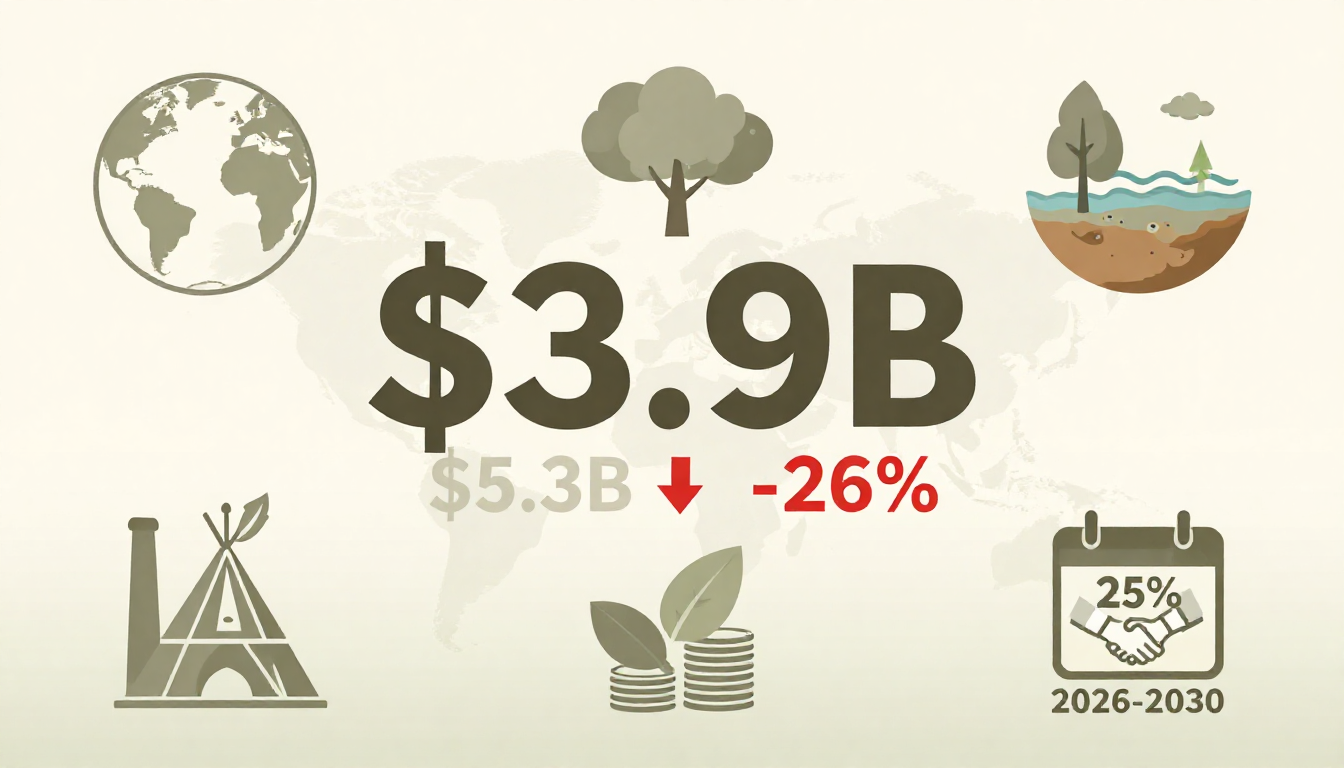
The number: $3.9 billion.
That sounds like a lot. And it is. But here’s the problem. Four years ago, for the previous funding cycle, donors gave $5.3 billion. So we’re looking at a drop of roughly 26%.
The money is supposed to cover four years of work, from July 2026 through June 2030. That’s the same period when the world is supposed to be accelerating action on climate and biodiversity. Instead, the fund is starting with a shorter runway.
Why the shortfall?

Ask anyone following development finance right now and they’ll give you the same answer: governments are stretched.
Russia’s war in Ukraine has pushed European nations to ramp up defense spending. Inflation ate into budgets. And in some donor capitals, political winds have shifted away from international environmental commitments.
The UK is a recent example. It announced cuts to green finance to free up cash for defense. Other countries are quietly doing the same, even if they won’t say it publicly.
The GEF’s interim CEO, Claude Gascon, tried to put a positive spin on things. He stated that donors “rose to the challenge” and that the pledges convey a message that “the world is not abandoning nature, even amidst competing priorities.”
That’s one way to see it.
Another way comes from Brian O’Donnell at Campaign for Nature. He called the trend “alarming.” His argument is simple: cutting nature finance now just pushes the cost down the road. And when you finally have to pay, it’ll be much pricier.
The US did something unexpected
If you’ve been following US climate politics, you’d expect the opposite of good news. The Trump administration gutted international climate programs. But here’s the twist: Congress actually increased the US contribution to the GEF by $150 million.
Why? According to people familiar with the negotiations, the GEF shifted some of its focus toward things Republicans in Washington care about – biodiversity, plastic pollution, ocean ecosystems – and away from purely climate-centric language. That reframing worked, at least this time.
In the last cycle, the top donors were Germany ($575 million), Japan ($451 million), and the US ($425 million). We won’t know exactly who gave what this time until the GEF’s 186 member countries meet in early June.
Where will the money go?
The GEF has already approved spending guidelines for the $3.9 billion. Two numbers stand out:
- 35% must go to the poorest countries and small island states – the ones that did almost nothing to cause the climate crisis but are already drowning or drying up because of it.
- 20% is earmarked for Indigenous Peoples and local communities. That’s significant because Indigenous territories are often the best-protected forests on Earth. Paying the people who actually live there to keep trees standing is one of the cheapest, most effective climate solutions out there.
The fund also wants to shift five big systems: nature, food, cities, energy, and health. The idea is to stop rewarding destruction, cutting down forests for soy, and burning coal for power, and start rewarding regeneration.
There’s also a new target to use 25% of the budget for blended finance. That’s a fancy way of saying: use public money to pull private money off the sidelines.” Wealthy countries love this approach because it doesn’t show up as “aid” on their ledgers.
What happens next?
The GEF Council meets from May 31 to June 3 to sign off on the final replenishment package. Between now and then, a few more pledges might trickle in. But don’t expect to close the $1.4 billion gap.
So here’s where we are. The world’s biggest fund for nature and climate just got a smaller check than last time. At the exact moment when science says we need to be moving faster.
You don’t have to be an environmentalist to see the problem. You just have to know how compound interest works on carbon, on extinction, on debt. The longer you wait, the worse the math gets.