Applications are now open for the 2026-2027 cohort.
What if AI could actually understand how science happens in the real world—not just the polished results in published papers, but the messy, human, instrument-laden, failure-filled reality that defines laboratory work? That’s the ambitious vision behind the Transfyr AI Fellowship, and it’s looking for exceptional graduate students to help make it a reality.
The Problem: Science Is Missing an Observability Layer
Scientific work is rich with tacit decisions, failed attempts, operator judgment, noisy instruments, and context that never makes it into a protocol. When researchers publish their findings, they present a clean narrative that omits the countless dead ends, subtle adjustments, and hard-won expertise that actually produced the results.
The next generation of scientific AI needs to reason over that reality—not just polished papers and clean benchmarks. But currently, there’s no dataset, no framework, and no system that captures the full richness of scientific execution.
Transfyr is changing that by building the world’s largest multimodal dataset of scientific execution. And they’re inviting you to come play with it.
What Is the Transfyr AI Fellowship
This is a one-year, full-time research fellowship for exceptional graduate students ready to lead a project solving frontier machine learning problems that impact real-world scientific systems. Fellows join full-time for 12 months to define a research question, build prototypes, analyze real multimodal scientific-execution data, and produce publishable or demo-grade research artifacts.
Key Details at a Glance
| Feature | Detail |
|---|---|
| Commitment | Full-time for 12 months |
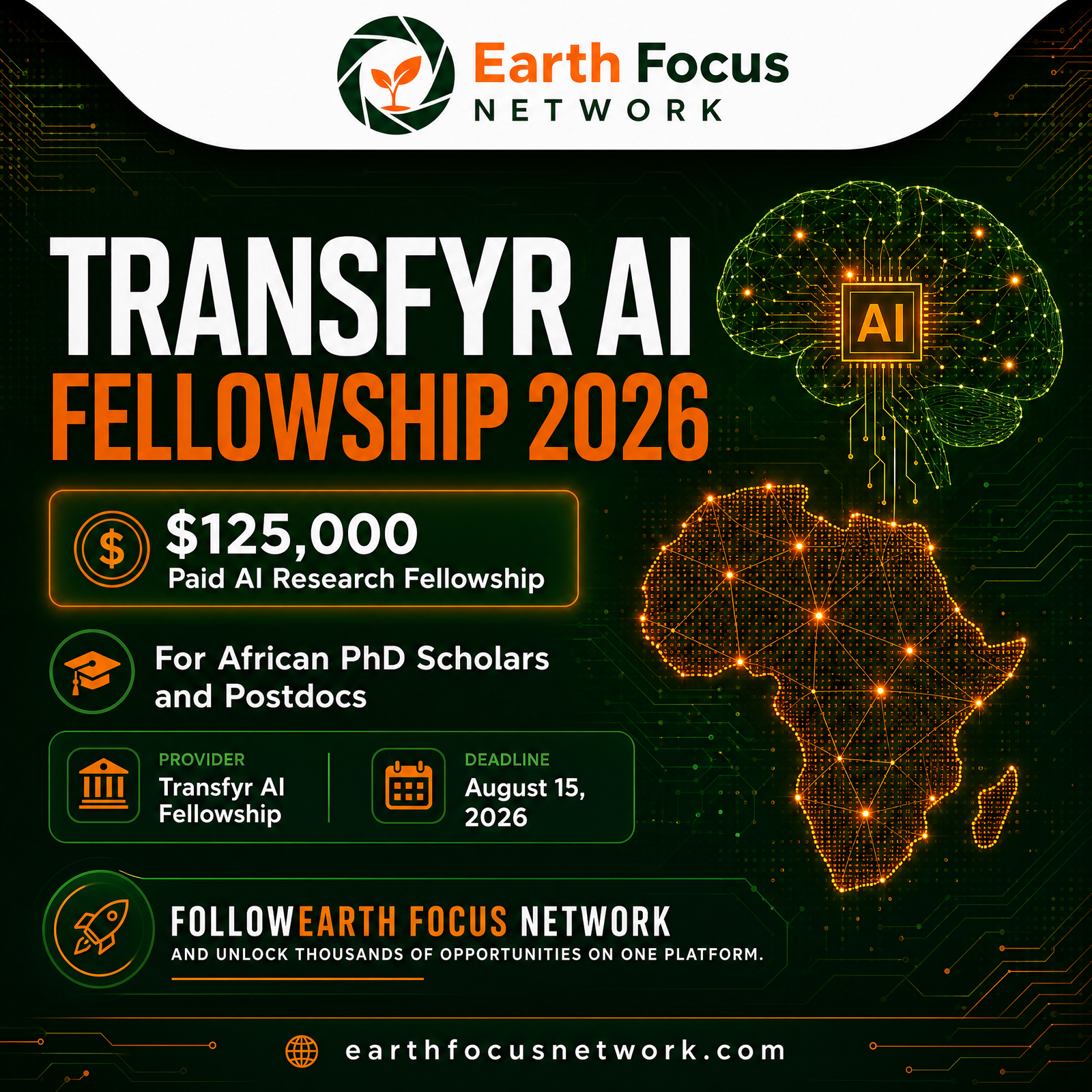
| Compensation | $125,000 + benefits + compute/resources |
| Start Date | Around September 2026 |
| Location | Boston/Cambridge full-time; remote by exception |
| Who Can Apply | Current graduate students (able to take leave), recent PhDs, and postdocs |
| Deadline | Apply by August 15, 2026 for full consideration |
The Research Agenda: Eight Frontier Challenges
Fellows will work on ML systems that need to understand scientific work as it actually happens—across people, instruments, protocols, repeated attempts, automation, and real outcomes. The research agenda spans eight interconnected challenge areas:
01 Multimodal Reasoning
Build models that align video, audio, protocol text, instrument traces, timestamps, gaze, and outcomes into a coherent account of what happened. This involves cross-modal grounding, temporal event extraction, and human activity understanding.
02 Conflicting Evidence
Real systems disagree. Explore how models represent, weigh, and explain conflicting signals across people, sensors, protocols, and results. Key areas include uncertainty calibration, evidence attribution, and contradiction-aware reasoning.
03 Long-Context Scientific Memory
Lab work unfolds over hours, days, and repeated attempts. The research challenge is deciding what to remember, compress, compare, and retrieve. This involves long-horizon state tracking, retrieval over process histories, and failure and deviation memory.
04 Real-World Evaluations
Design evaluations where success means better transfer, fewer hidden errors, stronger operator training, better automated execution, and more reproducible scientific outcomes. This includes benchmark design, process-level metrics, and lab-grounded model assessment.
05 Tacit Expertise
Model the invisible parts of expert work: attention, sequence, heuristics, small corrections, and the judgment calls that separate written protocol from reproducible execution. Focus areas include expert-novice comparison, skill representation, and human-in-the-loop feedback.
06 Physical-World AI
Help bridge foundation models, robotics, and lab work by studying how models and agents can learn from demonstrations in environments that are variable, constrained, and consequential. This involves embodied data pipelines, transfer across settings, and policy and assistance evaluation.
07 Biosecurity and Bio-Risk Observability
Static checklists cannot secure frontier biology. Fellows will develop ML systems that monitor live laboratory workflows to evaluate real-world capability, design dynamic evals, and autonomously identify risks that can be mitigated through technical guardrails. This includes synthesis-to-execution verification, emergent capability tracking, and autonomous vulnerability detection.
08 Scientific Execution Ontology
Disentangling biological signal from procedural artifacts requires more than labels. Fellows will build ontology-driven systems that capture protocol metadata at the level experimentalists and automation experts actually reason about: stock prep, concentrations, solubility limits, freeze-thaw history, plate setup, curve shapes, and execution context. This enables models to surface real phenotypes instead of trusting noisy growth/no-growth labels. Areas include wet lab-grounded metadata design, cross-domain causal attribution, and multi-scale variability mapping.
What You Will Gain
This isn’t just another research position. It’s a transformative year that will accelerate your career and place you at the cutting edge of AI for science.
Lead a Bold Research Project: Define your own research question, build prototypes, and analyze real multimodal data. You’ll have the freedom to explore frontier problems with genuine scientific stakes.
Close Mentorship: Receive direct mentorship from Transfyr’s founders, technical team, and advisor network across AI, biology, robotics, scientific operations, and applied R&D.
Access to Unprecedented Resources: Work with the world’s largest multimodal dataset of scientific execution, plus access to compute, GPUs, and project support.
Make a Real Impact: Your work won’t just produce papers—it will contribute to tools that make scientific execution observable, reproducible, and automatable. Promising solutions may be implemented into real-world contexts and products.
Build Your Network: Join a community of researchers, operators, and engineers working at the intersection of frontier AI and real-world science.
Who Should Apply
Transfyr is looking for exceptional researchers who bring:
- Strong ML Fundamentals: You have a deep understanding of machine learning concepts and techniques, backed by hands-on experience.
- Exceptional Research Taste: You know what problems are worth solving and can identify high-impact directions.
- Comfort with Ambiguity: You thrive when the path isn’t clearly defined and can navigate open-ended research challenges.
- Curiosity About Science: You want to understand how science actually happens in physical environments and are excited to build AI that captures that reality.
Eligible applicants include:
- Current graduate students (able to take leave)
- Recent PhDs
- Postdocs
- Fields: Machine Learning, Computer Science, Computational Biology, Robotics, Human-Computer Interaction, Statistics, and adjacent fields
Program Terms
Compensation: $125,000 annual compensation plus benefits
Time Commitment: Full-time for 12 months. Current students should self-certify that they can take leave or otherwise commit full-time.
Location: The fellowship is designed around full-time in-person work in the Boston/Cambridge area. Remote arrangements may be considered by exception when the project and candidate make it workable.
Visa Support: International applicants are welcome. Visa support is available for selected fellows.
Research Output: Fellows should aim to produce a publishable research artifact, benchmark, dataset, demo, prototype, or equivalent technical contribution. Fellows will have the opportunity to implement promising solutions into real-world contexts and products. Transfyr owns fellowship work product and supports publication subject to confidentiality and IP review.
Compute and Research Support: Fellows will have access to compute, GPUs, data, and project support. Tell them what resources your research proposal needs.
Application Timeline
Applications are reviewed on a rolling basis:
| Stage | Date |
|---|---|
| Rolling Review | Applications reviewed as they arrive |
| Full Consideration | Apply by August 15, 2026 |
| Decisions | Rolling through late August 2026 |
| Fellowship Begins | Around September 2026 |
How to Apply
The application process is intentionally efficient—just one page. Tell them what you want to work on and what resources you need.
Application Inbox: ai_fellowship@transfyr.ai
Application Materials:
- A one-page application outlining your research interests and proposed direction
- Links that make your work easy to evaluate (GitHub, papers, projects, etc.)
- The compute, GPU, data, or support your project would need
Before Applying, Ensure You:
- Are a current graduate student, recent PhD, or postdoc
- Can start around September 2026
- Can be based in Boston/Cambridge full-time
- Can specify the resources your project requires
- Are ready to provide references if selected as a finalist
Why This Matters
Science is at an inflection point. Advances in AI have the potential to accelerate scientific discovery, improve reproducibility, and transform how research is conducted. But to realize that potential, we need AI systems that understand science as it actually happens—not just the sanitized version that appears in publications.
The Transfyr AI Fellowship is building the foundations for that future. By tackling frontier ML problems with real scientific stakes, fellows will contribute to work that could reshape how science is done.
If you’re ready to move beyond clean benchmarks and start building AI that understands the reality of scientific work, this is your opportunity.
Ready to apply?
Submit your one-page application to ai_fellowship@transfyr.ai by August 15, 2026.