No prototype needed. No equity taken. Just a smart distribution plan and the ambition to change the world.
The global poverty landscape is littered with brilliant inventions that never reach the people who need them most. A life-saving water filter sits in a lab while children drink contaminated water. An affordable solar light collects dust while families burn kerosene. A proven nutritional supplement remains in a warehouse while children go hungry.
D-Prize exists to close that gap.
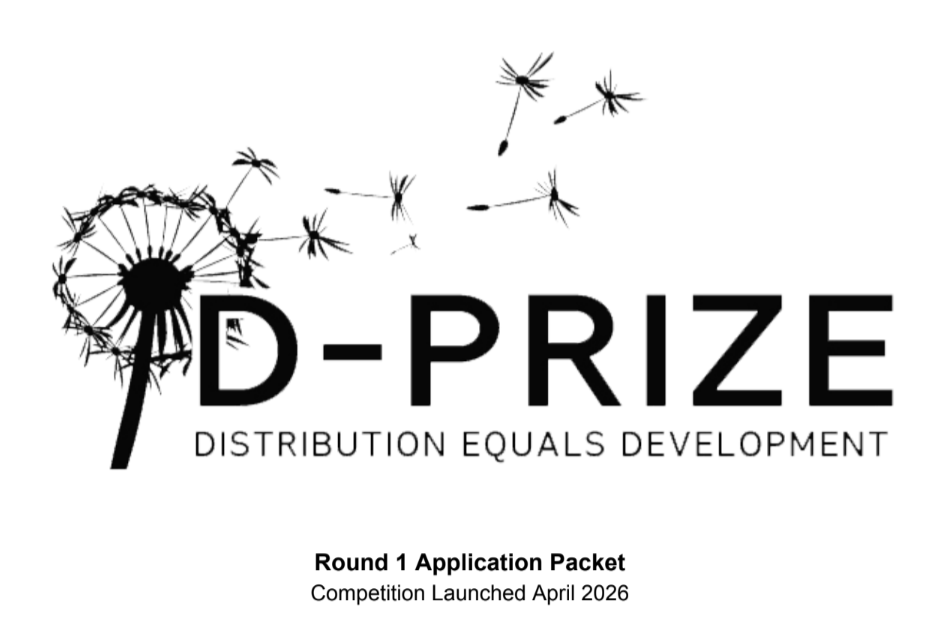
The global competition is now accepting applications for its 2026 cycle, offering up to $20,000 in convertible grant funding to entrepreneurs who can design scalable distribution models for already-proven poverty interventions. Not prototypes. Not new inventions. Just smart, cost-effective ways to get existing solutions into the hands of people in the developing world.
“We don’t fund prototypes of promising new interventions,” the competition rules state plainly. “We fund distribution.”
And here’s the best part: You’re not competing against other applicants. D-Prize typically funds at least 15 proposals per competition, regardless of which challenge track you choose.
Three Deadlines: Choose Your Path
D-Prize operates on a rolling submission schedule with three distinct deadlines. The earlier you submit, the sooner you’ll receive a decision.
Early Decision Deadline: May 17, 2026 at 23:59 Pacific Time (UTC -7)
Submit early, hear back sooner. This is the fastest path to a decision.
Regular Deadline: June 7, 2026 at 23:59 PT
The standard submission window. Still plenty of time to craft a strong proposal.
Extension Deadline: June 28, 2026 at 23:59 PT
Limited to those who register in advance. If you need extra time, register at www.d-prize.org/extension before slots fill up.
All proposals are submitted through the D-Prize portal at www.d-prize.org/submit, along with resumes for each team member.
Who Should Apply? (Hint: It Might Be You)
D-Prize is looking for a specific kind of person. Not necessarily someone with a fancy degree or years of nonprofit experience. Instead, they want someone who fits this description:
You have enormous ambition. You can actually imagine yourself as a successful entrepreneur. Not in a vague, someday-maybe way, but in a real, tangible, “I could do this” way.
You are ready to launch. If the pilot proves successful, you’re excited to grow your venture into a world-changing organization—not just a side project.
You have a plan to go all in. If you’re still a student or have existing job commitments, you need a clear idea of how you’ll transition into a full-time founder role.
D-Prize is open to any business model—for-profit, non-profit, or anything in between. The organization doesn’t care about your legal structure. It cares about your ability to distribute proven solutions at scale.
The Rules: Simple but Strict
Before you get excited, understand the boundaries.
Your proposal must focus on distribution of an already-proven poverty intervention. That means you cannot propose to invent something new. You cannot propose to run a clinical trial. You cannot propose to test whether something works. You must take something that already works and figure out how to get it to more people.
Choose from D-Prize’s distribution challenges. Available challenges are listed at www.d-prize.org/#challenges. These cover sectors like global health, agriculture, energy, water, sanitation, financial inclusion, and education.
Proposals must be written in English—but perfection isn’t required. Grammar errors and awkward vocabulary will not be penalized. The judges only want to understand your idea.
No extra materials. Only the concept note and resumes will be considered. Revisions after submission are not accepted. And only one proposal per person or partnership will be reviewed.
The Three-Round Journey to Funding
Winning a D-Prize grant is not a single submission. It’s a process designed to separate good ideas from truly great ones.
Round One: The Concept Note
This is where you start. You’ll submit a two-page concept note (three pages if applying to a Custom Challenge) plus one-page resumes for each team member.
The concept note must answer three big questions:
- How does your venture improve distribution of your chosen intervention? Walk the judges through your model step by step. What barriers currently prevent access? How will you overcome them? What is the single most fundamental assumption you need to prove during your pilot?
- What is the expected impact? Be specific. At a high level, what will change? At an individual or household level, what will change? Then provide a simple outcome table showing how many interventions you plan to distribute over three months, one year, and two years, and how many people you will directly help.
- Who is your team? List everyone, their roles, their locations during the pilot, any other commitments they have, and their relevant experience. If team members aren’t local to the operating region, explain any developing country experience they have.
You’ll also need to summarize your pilot budget: roughly how much money you need and what the three to five major expenses will be. And finally, one sentence summarizing your long-term vision for the organization.
Pro tip: Be succinct. Successful proposals are objective and to the point. Judges are already familiar with the macro-level problem—you don’t need to include large statistics or global market sizes. Focus on your specific model, your specific region, and your specific plan.
Round Two: The Full Proposal
If your concept note advances, you’ll receive an invitation to Round Two. This is where things get more detailed.
You’ll be asked to respond to several pages of short written questions covering your operations, budget, milestones, and other operational details. Participants receive a full Round Two Proposal Packet with instructions, and you’ll have about two weeks to submit.
Final Round: The Interview
Entrepreneurs who make it to the Final Round will interview with judges over email and by phone. This is your chance to bring your idea to life, answer tough questions, and demonstrate why you’re the right person to lead this venture.
Based on the promise and cost-effectiveness of your proposal, judges may award up to $20,000. The average D-Prize award size is $16,000.
What the Judges Are Looking For
The judging panel is composed of people with real professional experience distributing life-changing technologies in the developing world. They’ve walked the walk. They know what works and what doesn’t.
They evaluate proposals based on three criteria:
Passion and potential. Does your academic and professional background suggest you can succeed? Do you have relevant skills? Is there evidence of a quick leadership trajectory?
Focus on distribution. Is your proposal squarely about distributing a proven poverty solution? Or did you drift into invention, research, or unrelated activities?
Potential for scale. Is your organizational model designed for growth? Do you have the desire to commit and expand if the pilot succeeds?
Tips From the D-Prize Team
The application packet includes some unusually honest advice. Take it to heart.
Be succinct. Successful proposals are objective and to the point. Orient your writing toward an educated judge who already understands the key issues. No need to explain poverty or why clean water matters.
Focus on scale, impact, and cost-effectiveness. Build a plausible case that your intervention is highly scalable, cost-effective, and will lead to enormous impact relative to the investment.
Keep within scope. The most successful startups have a narrow focus. They avoid spending resources on too many areas. A tightly scoped idea will perform best in this competition.
What Winners Receive (Beyond the Money)
Yes, you get up to $20,000 in convertible grant funding—no equity taken, no repayment required if you’re a nonprofit.
But the support doesn’t stop there.
D-Prize can help your venture attract future funding if your pilot proves successful. You’ll gain access to the D-Prize network of past winners—entrepreneurs who have walked this exact path and can offer guidance, introductions, and hard-won lessons.
And you’ll join a community of founders who are all working toward the same goal: scaling proven solutions to the people who need them most.
Custom Challenge and Existing Organizations
Custom Challenge applicants: If you’re submitting to a Custom Challenge category, you must provide a URL linking to credible evidence that supports your intervention. You may also add one additional page to your concept note (bringing the total to three pages) elaborating on your intervention and citing evidence that it is proven and in need of greater distribution. Without credible sources, your proposal will be declined.
Existing organizations: If your organization has already launched, you must include a summary of your activities since launching and your current budget or income statement in the submission webform.
A Note on AI and Grant Writing Services
D-Prize understands that some people use AI tools and professional writing services. The organization is not opposed to this. But here’s the honest truth from the D-Prize team:
“Our evaluations are not at all based on the quality of your writing and grammar. Instead, we evaluate the quality of your idea—and we think the only path to a great idea is when a smart person (you) has spent time thinking deeply about a problem and designing a solution. We don’t think ghostwriters or AI can replace this.”
In other words: Use AI if you want. But don’t outsource your thinking. The best proposals come from founders who have done the hard mental work themselves.