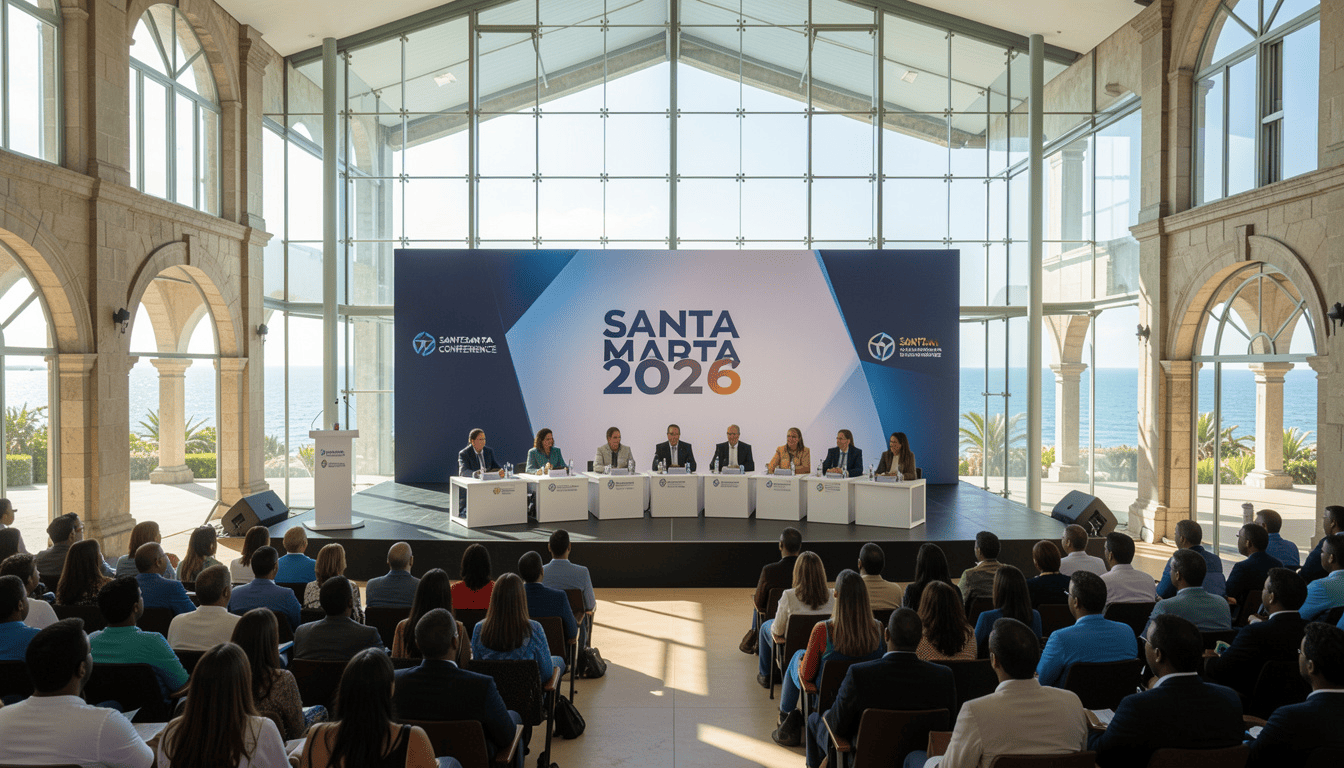
About.
Date: April 24–29, 2026
Location: Santa Marta, Colombia
Hosts: Colombia & The Netherlands
Focus: Fossil fuel transition, economic diversification, supply and demand transformation, international cooperation.
Let me tell you why this conference is different.
You’ve heard it before. “This time it’s different.” Every climate conference promises to be the one that finally moves the needle. Then nothing changes.
But Santa Marta? Actually different.
Here’s why.
For starters, the UN isn’t running the show. No consensus rules. No petrostates quietly watering down language in back rooms. No diplomats spending three days arguing over a single comma.
Instead, this is a coalition of the willing – countries that are already moving away from fossil fuels and want to figure out how to do it faster, together.
And get this: the 85 countries that backed a fossil fuel phase-out roadmap at COP30? Combined, their economies are bigger than the United States. Add California (the world’s fourth-largest economy), and you’re looking at economic heft roughly equal to the US and China combined.
That’s not a fringe movement. That’s a superpower.
Wait – why Santa Marta? Why Colombia?
Colombia is an unlikely leader in this space.
The country still depends on fossil fuels for about 10% of government revenue and 4% of GDP. President Gustavo Petro’s decision to halt all new oil and gas exploration was called “political and economic suicide” by his predecessor.
But Colombia is doing it anyway.
And now, Colombia is hosting the world’s first conference dedicated entirely to implementing – not just negotiating – the transition away from fossil fuels.
The location matters, too. Santa Marta is on Colombia’s Caribbean coast. Beautiful. Historic. A place you’d actually want to visit. But also a region facing real climate impacts. The conference isn’t hiding in a luxury resort. It’s putting the conversation on the front lines.
What’s actually happening there?
The conference runs April 24-29, 2026, with a packed agenda built around three thematic pillars.
Pillar 1: Overcoming Economic Dependence on Fossil Fuels
This is the hard one.
Nearly 78% of global fossil fuel reserves are in the Global South. At least 38 developing countries are net exporters. For them, oil and gas aren’t just products – they’re the thing keeping governments running, debts paid, and people employed.
You can’t just tell these countries “stop drilling” without answering the obvious question: And then what?
The conference will tackle fiscal dependency, debt vulnerabilities, and economic reconversion. How do you build new industries? How do you retrain workers? How do you avoid swapping one form of extraction for another?
Pillar 2: Transforming Supply and Demand
This pillar has two sides.
On the demand side: Fuel switching (replacing fossil fuels with renewables), energy security, and – this is important – closing new demand drivers. The petrochemical sector is the single largest source of future oil demand growth. By 2030, it’s projected to account for over one-third of oil demand growth. By 2050? Nearly half.
That’s not just about cars and power plants anymore. That’s about plastic. Fertilizer. Synthetic fabrics. Medical equipment. The stuff of everyday life.
On the supply side: Reducing fossil fuel extraction. The IEA is clear – renewables need to replace fossil output, not just supplement it. No new coal plants. No new gas infrastructure that locks in emissions for decades.
Pillar 3: International Cooperation and Legal Frameworks
This is where things get technical – and interesting.
The conference will address trade policies, investment agreements, and legal barriers to the transition. Things like Investor State Dispute Settlement (ISDS) mechanisms, where fossil fuel companies can sue governments for lost profits when they phase out extraction.
If you’ve ever wondered why some countries move slowly on climate policy, this is part of the answer. The legal risks are real. Santa Marta is where they’ll start untangling them.
Who’s actually coming?
As of March 30, 2026, 45 countries have confirmed their participation – representing about one-fifth of global fossil fuel production and nearly one-third of global consumption.
The list includes:
- Vulnerable nations: Tuvalu, Vanuatu, Palau, Fiji, Maldives, Marshall Islands
- Major producers: Canada, Norway, Australia, Angola, Trinidad and Tobago
- European leaders: Germany, France, Spain, Netherlands, Sweden, Finland, Portugal
- Emerging economies: Brazil, Mexico, Vietnam, Cambodia, Senegal, Tanzania
Also attending: the European Commission, the COP30 Presidency (Brazil), and the COP31 Presidency (Türkiye).
That last one matters. Whatever comes out of Santa Marta is expected to feed directly into COP31 in Antalya this November.
What’s the vibe? (Be honest.)
This is not a typical COP.
No red carpets. No celebrity activists (probably). No countries hiding behind “national circumstances” to avoid committing to anything.
The guiding principles tell you everything:
- Participation by those ready to move forward – not a space for persuasion or debate about whether the transition should happen
- Implementation as the guiding star – focus on solutions, not further diagnosis of the problem
- Focus on real solutions – not things that delay or distract
In plain English: If you’re not serious about moving away from fossil fuels, don’t bother showing up.
The conference is also deeply participatory. Over 2,600 organizations and communities have already joined preparatory virtual dialogues. Indigenous Peoples, Afro-descendant communities, peasants, workers, youth, academics—they’re not side events here. They’re central.
What will actually come out of this?
The conference aims to produce a synthesis report identifying concrete pathways for implementing a just, orderly, and equitable transition away from fossil fuels.
But the real outcome is the coalition itself.
This isn’t a one-off meeting. Organizers envision a sustained political platform – a second conference, maybe a technical secretariat, definitely ongoing coordination.
And here’s the kicker: because this isn’t a UN process, majority rule applies. A handful of countries can’t block progress like they can at COP.
What are people saying?
Charlin Bodley, Caribbean renewable energy expert: “We must move beyond talk and leave with a framework that signals seriousness and provides solutions.”
Irene Vélez Torres, Colombia’s Environment Minister: “This is the moment to be honest about the challenges of moving away from fossil fuels. It’s not easy. It involves commitments from the Global North and South. It involves local interests and tensions. None of this reduces its urgency.”
Covering Climate Now (media organization): “A new economic superpower could spark a global retreat from fossil fuels. The underlying terrain of this conference will no longer be principally politics, but economics – the implacable market forces that shape the world economy.”
Peter Newell, Sussex University professor: “There’s no turning back. The conference outcomes could include declarations on key principles and next steps that breathe new life into the fossil fuel transition agenda at UN climate talks.”
Why you should care (even if you’re not attending)
Three reasons.
First – The petrochemicals conversation is happening here, and it matters for everything you buy. Fertilizer. Plastic packaging. Synthetic clothing. Medical supplies. The war in Iran has exposed how fragile these supply chains are. Santa Marta is where they’ll start talking about fixing that.
Second – The coalition being built here will shape COP31 in November. Whatever emerges in Santa Marta will walk into Antalya with momentum that petrostates can’t easily block.
Third – This is the first time a major climate conference has been organized around implementation, not negotiation. If it works, it changes the game. If it fails, we’ll know that even coalitions of the willing can’t move fast enough.
Either way, you’ll want to know what happened.
Bottom line
The Santa Marta Conference isn’t trying to save the world in six days.
It’s trying to build something that doesn’t exist yet: a coalition of countries willing to move without waiting for everyone else.
85 countries. $50+ trillion in combined GDP. A mandate to actually implement, not just negotiate.
Will it work? Nobody knows.
But for the first time in a long time, something in climate diplomacy feels like it’s moving forward – not just spinning in place.
And that’s worth paying attention to. Learn more here